
Other methods make you better in the conversation. Upstream Selling decides which conversation you are in.
Most sales methods are craft in the room. Which questions to ask, in what order, how to meet objections. They make the seller more skilful in the conversation already under way.
The craft was built when the seller held information the customer lacked. That advantage has shrunk dramatically. Google, industry reports, your own network, and now AI tools that summarise an entire market in a minute. The customer finds out most of it alone, before any supplier is in the picture.
The seller’s skill remains, but it is exercised more and more often inside a picture of the problem the customer has already worded.
Upstream Selling sits one level above. Other methods take the conversation as given and make you better in it. Upstream Selling decides which conversation it becomes, and with that, what it will be about.
The two do not exclude each other. Standing upstream, the sales craft does great work, from prospecting to negotiation. But it raises execution in the position you already hold. It does not move you there.
Early is not the same as upstream. More calls and tighter follow-up move activity. What moves position is what you bring: an insight into the customer’s own business that they did not have before.
The same goes for the methods built on understanding the customer more deeply: consultative selling, questioning frameworks such as SPIN, value-based selling, relationship selling. They differ in craft but rest on the same assumption: that the answer sits with the customer, and that your job is to ask questions until it surfaces. The customer often knows a great deal. But in a complex deal it is hard even for a well-read buyer to know what weighs heaviest, whether the priorities are right, or whether the organisation even agrees on what the question is. However skilfully you ask, the answer is no better than the picture the customer already holds. Upstream Selling starts from the idea that the picture is to be shaped, not found. The difference is not one of degree. It is one of direction.
Think you already work this way? Then the analysis is the fastest way to show we are wrong about you.

Where in the customer's thinking are you?
The modes describe where in the customer’s thinking you stand. The same customer, the same offer and the same seller can make three entirely different deals depending on mode.
Downstream.
Midstream.
Upstream.
Mode says where the deal is decided. Role says how you are perceived once you are there.
Role and mode are not the same thing. Two sellers can stand in the same mode and still be perceived entirely differently by the customer.
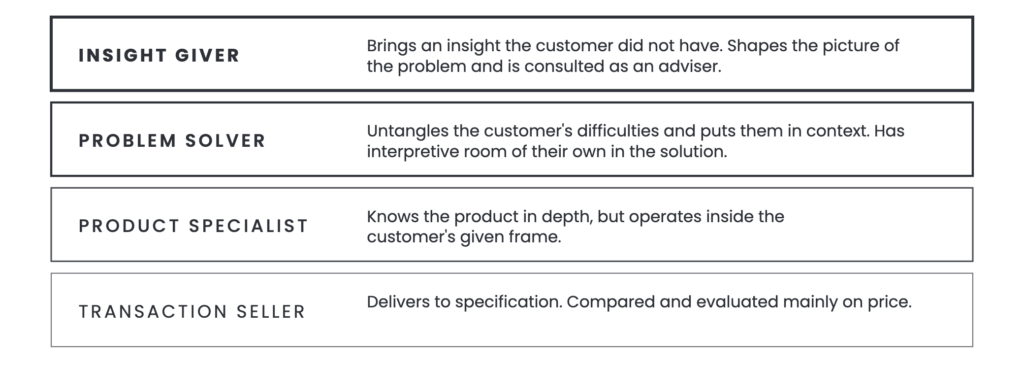
INSIGHT GIVER Brings an insight the customer did not have. Shapes the picture of the problem and is consulted as an adviser.
PROBLEM SOLVER Untangles the customer’s difficulties and puts them in context. Has interpretive room of their own in the solution.
PRODUCT SPECIALIST Knows the product in depth, but operates inside the customer’s given frame.
TRANSACTION SELLER Delivers to specification. Compared and evaluated mainly on price.
The role decides which question you are asked. The Insight Giver is asked what the customer ought to do. The Transaction Seller is asked what it costs.
The role is not a title and it is not fixed. It is set by what you bring to the individual deal, and that is why it can be changed even in a deal already out for procurement.
The same request, two entirely different deals.
A consultancy with two thousand employees sends out a request for new work laptops. Two of the suppliers reply the same week.
The first writes: we can deliver two thousand laptops at a competitive price, with roll-out, support and take-back of the old equipment. May we send a quotation?
The second writes: we can of course respond in full to your request, but before we set a price we want to understand one thing. You have said that utilisation is to rise ten per cent this year. Our experience from similar consultancies is that the lost time is rarely where people think it is: it gathers around a few roles with heavy tools, and it does not show in the time reports, because time spent waiting, restarting and troubleshooting rarely gets invoiced. So we want to start by mapping which roles lose the most time, and to what, before we price equipment per role. Which roles are meant to deliver those ten per cent, and what is holding them back today?
The first lands with procurement and is decided on price. The second lands with the person who owns the outcome, and earns a conversation.
The same brief, the same week, the same product. The difference is not a way with words. The second arrives with a picture of the customer’s business the customer recognises, built on what they have seen at similar firms, instead of a run-through of their own range, offer and price.
That is also why they land with different people. A price is a procurement question. Utilisation is someone else’s.

The request has arrived. You can still influence what the deal is judged on.
The most common objection to upstream work is that it only applies to deals you find early, before a request has landed on the table.
That is not true, and it is why upstream is a choice and not a point in time.
Respond to the brief exactly as asked. That is necessary, and it is what keeps you in the process. But it does not set you apart from anyone, because everyone else is doing the same.
Then offer a working session on what the brief does not ask about: what you believe is missing from the customer’s picture of the problem, what that gap is costing them, and what you can do about it.
The last part is not optional. A gap without a proposal is an observation, and an observation is not something the customer can buy.
What you bring to that session is not objections to the requirements. It is your reading of the customer’s own situation, and it explains why something is missing.
That is where you stop being one of several answering the same questions. You become the supplier who saw something the customer had missed, and who can show what it is worth doing something about.
You are then judged on something your competitors have not shown. It is the single biggest difference you can make in a deal that has already begun.

Position is not a feeling. It is measured along four dimensions.
Four dimensions decide where you stand. Each is a question about a live deal, and the answer must hold up against something you have seen or heard.
Position in the buying journey. Where did you enter the decision process? Were you there when the problem was worded, or were you invited once the solution had already taken shape?
Language and concepts. Does the customer use your language when the problem is described, or a competitor’s? If the customer does not use your words and concepts internally, your arguments do not carry either.
Buying criteria. Do the criteria reflect your strengths or not? Criteria are never neutral. If you were not there when they were written, it was not you who decided which of your strengths get evaluated.
Value articulation. Can the customer explain why your solution matters, without you in the room? If not, no one can argue your case when the decision is justified internally.
These are the four dimensions the Upstream Selling analysis measures. The distance between where you think you stand and where you can evidence that you stand is what we call the position gap.

You can choose
where to be.
The model is easy to understand. The hard part is knowing where you actually stand in a live deal.
That decides what the next move is. Standing in Downstream, the move is to offer a working session on what the brief does not ask about. Standing in Midstream, the move is to challenge at least one criterion before it is locked, and to get in what the criteria do not yet evaluate. Standing in Upstream, the move is to have the requirements written from the picture of the problem you helped shape.
A move that suits Upstream does not work in Downstream. And a feeling will not do for an answer, because most sales teams place themselves higher than they can evidence.
Pick a deal you are working on now and answer twelve questions. Four to five minutes, anonymous, nothing is stored.
